
A small practice for today
Daily Zen: Today’s Quote, Koan, and One-Minute Meditation
Open today’s Zen quote and koan, then take one minute to breathe. Use one part or all three and carry what is useful into the next ordinary moment of your day.
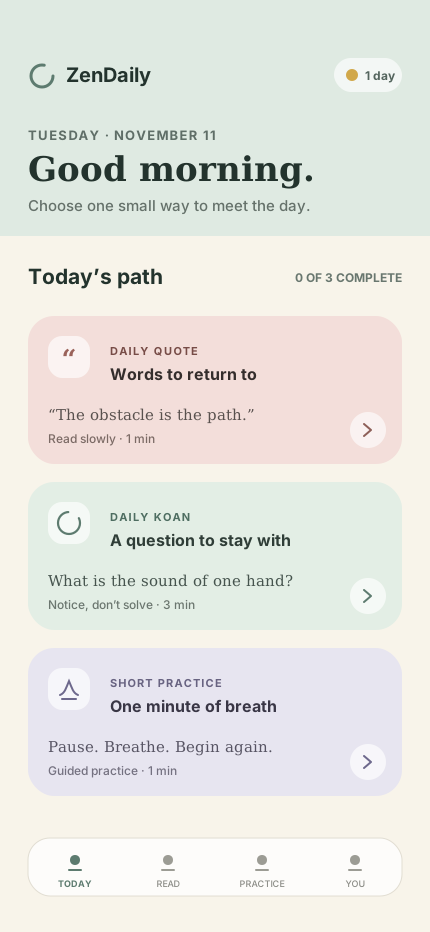
Today’s Daily Zen
One reflection, one koan, one minute.
The path changes with the day. Use one part or all three, then continue without measuring whether the practice was good enough.
Do not rush past the life inside an ordinary task.
Let washing, walking, or waiting be complete while it is happening.
A student asked, “What is the Way?” Nansen answered, “Ordinary mind is the Way.”
The Gateless Gate, Case 19
For one minute, feel the movements already happening: breathing, hearing, and the body balancing.
At a glance
A simple place to begin
- One quote is enough when you read it without rushing.
- A koan can remain open instead of becoming a puzzle to solve.
- One minute of breathing can reconnect reflection with the body.
- Missing a day does not erase the practice; simply begin again.
How to use today’s reflection
The daily path above changes with the date. Begin with the reflection and read it once without trying to agree. Notice the immediate response: relief, doubt, resistance, recognition, or perhaps nothing at all.
Bring the line close to something real. You may be waiting for a message, trying to finish a task, or wishing your mood would improve before the day continues. A reflection becomes useful when it meets an actual moment rather than remaining an attractive sentence.
The lines in this rotation are original ZenDaily reflections, not quotations assigned to historical teachers. That distinction matters. Zen teachings are often detached from their sources online, so this page labels traditional cases and original writing separately.
How to carry today’s koan
Read the koan before reading an explanation. Notice how quickly the mind searches for a philosophical answer, a trick, or a phrase that will make the question disappear.
You do not need to stop that search. See it happen, then return to direct experience: the weight of the body, a sound nearby, light in the room, and the question itself. A koan can stay unfinished. Carrying it for a day is not delaying the answer; the carrying is part of the practice.
Some daily cases come from classic Zen collections, while others are practice questions in the same contemplative spirit. The source appears directly beneath the question. For a clearer introduction to the form, read what a Zen koan is.
How to take the one-minute practice
Settle into a chair or stand with both feet supported. Let the hands rest. Close the eyes or keep a soft gaze, then follow the invitation in today’s card.
Do not deepen or improve the breath. When thought pulls attention away, recognize that movement and return without commentary. For the final breath, include the whole field: body, sound, thought, and whatever mood is present. Nothing has to disappear for the minute to be complete.
Then continue with the next activity slowly enough to notice its beginning.
How the three parts work together
The quote offers a direction. The koan unsettles the mind that wants to turn that direction into a fixed rule. The short practice brings both back into the body.
You can use only one part. On a busy morning, read the reflection and leave. During a walk, carry the koan. Before bed, take the one-minute practice without reviewing whether the day was successful.
The sequence is intentionally small. Daily practice becomes harder to sustain when it demands a particular mood, an uninterrupted schedule, or proof of improvement. A modest form leaves room for actual life.
Daily does not mean perfect
The word “daily” can create pressure. A missed day starts to feel like a broken streak, and restarting can seem less satisfying than maintaining an unbroken record.
Zen practice offers another view. Each return is complete in itself. Yesterday’s absence does not make today’s breath smaller. Beginning again is not a repair to the practice; it is the practice appearing in this moment.
ZenDaily’s Today’s Path keeps a daily Zen quote, a koan, and a short practice together. It is there to reduce the effort of choosing, not to judge how often you arrive.
A fresh path each day
Carry today’s practice with you.
ZenDaily brings a daily quote, a daily koan, and a short practice into one quiet path. Follow one step or all three—there is no required order.
Scan to download Opens the right app store4.5 on the App Store · 4.1 on Google Play
Common questions
A little more clarity
What is a daily Zen practice?
A daily Zen practice can be as small as reading one teaching, sitting with one question, or paying attention to a few natural breaths. The important quality is direct attention, not the length or complexity of the routine.
Do I need to practice Zen every day?
No. A daily format makes practice easy to find, but it should not turn a missed day into failure. Return when you remember and begin with the moment that is available.
Can a quote or koan count as meditation?
A quote or koan can support contemplative practice when you meet it slowly and notice your response. It is different from formal seated meditation, but both can cultivate careful attention.
How long should a beginner practice?
One to five minutes is a reasonable beginning. Choose a duration that allows you to return without creating resistance, then increase it only when that feels useful.