
Koans, clearly introduced
What Is a Zen Koan?
A Zen koan is a teaching encounter, question, story, or phrase used to loosen habitual thinking and invite direct insight. It is less interested in the right explanation than in how you meet what cannot be neatly explained.
At a glance
A simple place to begin
- Koans developed from recorded encounters in the Chan and Zen traditions.
- They are used to challenge fixed concepts, not to reject clear thinking.
- A koan may be studied formally with a teacher or read as personal reflection.
- Context helps, but no summary can replace direct engagement.
A clear definition
A Zen koan is a compact teaching form that may appear as a dialogue, story, question, or striking phrase. Many koans preserve encounters between teachers and students. Others concentrate the encounter into a single line.
The form developed from records in the Chinese Chan tradition and became central to parts of Japanese Zen. The word is connected to the idea of a public case: something available for examination rather than a private opinion.
But a koan is not examined in the same way as a legal argument. It asks the practitioner to bring their whole attention to the case.
Why koans sound impossible
Ordinary questions assume a shared frame. If someone asks where a train stops, the answer belongs to a map and schedule. A koan often destabilizes the frame itself.
A student asks about ultimate truth, and the teacher points to something ordinary. A question seems to require two sides, and one side disappears. A statement contradicts the categories needed to understand it.
This is not nonsense for its own sake. The difficulty reveals how quickly the mind turns experience into fixed objects and explanations. When the familiar method fails, another kind of attention may become possible.
Koans and riddles are different
A riddle hides an answer. Once you know it, the puzzle is finished. A koan can remain alive even after years of study.
There may be traditional commentaries and accepted responses within particular teaching lineages. That does not make a koan a trivia question. In formal practice, the student’s response is part of an ongoing encounter with a teacher. Words, gestures, timing, and the student’s way of seeing all matter.
For a general reader, the safest orientation is simple: do not rush to solve, and do not pretend that confusion is automatically profound.
What koans are used for
Koans can serve several connected purposes:
- They bring hidden assumptions into view.
- They interrupt purely abstract discussion of Zen.
- They connect practice to concrete situations and ordinary objects.
- They test whether an insight is lived or merely repeated.
- They invite a response that includes the whole person.
Different Zen schools use koans differently, and not every Zen tradition makes them central. Zazen, ethical conduct, community, ritual, and study are also important parts of Zen life.
How a beginner can approach a koan
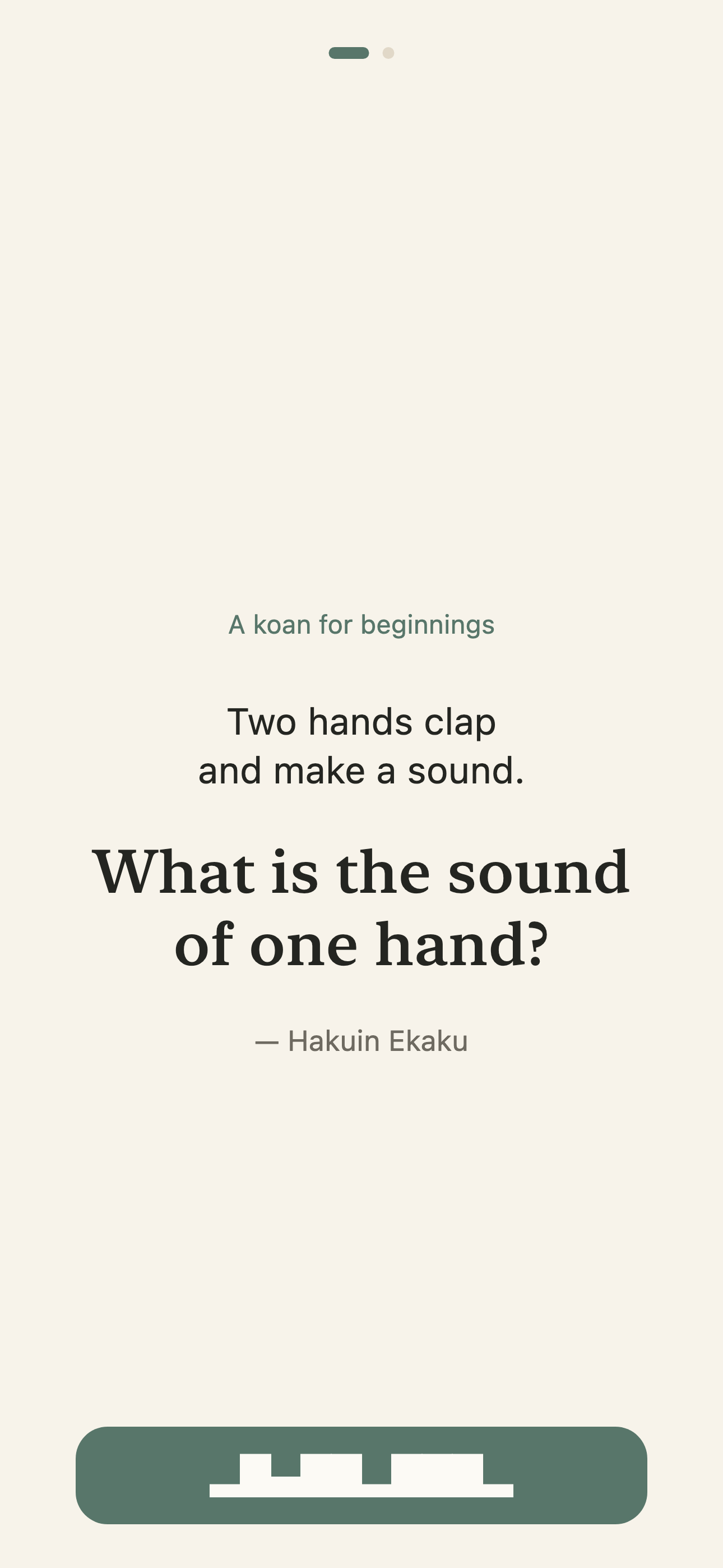
Start with one short case, such as the sound of one hand. Read it twice. Then notice what you want from it.
You can also begin with the Zen koan of the day, which keeps the practice small: one case, one point of context, and one invitation to pause before reaching for an answer.
Do you want a hidden meaning? A feeling of insight? Proof that the teacher is clever? The koan has already begun to work when these movements become visible.
You can sit quietly and keep the central phrase nearby without repeating it aggressively. When thought produces an answer, acknowledge it. Then return to the actual conditions of the moment: posture, sound, breath, and the felt quality of questioning.
The role of explanations
Historical and philosophical context matters. Without it, koans can be turned into inspirational slogans or performances of absurdity. Commentary can show how a case was used, identify translation issues, and clarify common mistakes.
Still, an explanation is not the same as the koan’s function. Reading that a koan points beyond dualistic thought is easy. Seeing dualistic thought arise in the middle of a conflict is another matter.
Use explanations to orient practice, not replace it.
A living question
The value of a koan is not limited to a meditation cushion. Modern life repeatedly asks for certainty where none is available. We build identities from comparison, defend positions before listening, and postpone action until the whole path is clear.
A koan can create a pause inside that momentum. The pause is not empty. It contains the next breath, the other person, the unfinished task, and the possibility of responding without repeating the first habit that appeared.
That is one answer to “What is a Zen koan?” It is a public case that becomes personal only when you meet it here.
From definition to direct experience
Meet the koan itself, not only its definition.
ZenDaily offers classic koans with approachable context and optional reflections, giving each question room to remain alive.
4.5 on the App Store · 4.1 on Google Play
Common questions
A little more clarity
Is a koan a riddle?
A koan can sound like a riddle, but its purpose is different. A riddle is usually solved by finding the intended answer. A koan is used to expose and transform the way a person approaches the question.
What does koan mean?
The term comes from a word meaning a public case or precedent. In Zen, it came to refer to records and expressions used for teaching and practice.
Do I need a Zen teacher to read koans?
Anyone can read and reflect on koans. Traditional formal koan training is relational and guided by a teacher, while informal reading can still offer a meaningful introduction.