
Daily Zen wisdom
Zen Quotes: Short Daily Quotes with Modern Reflections
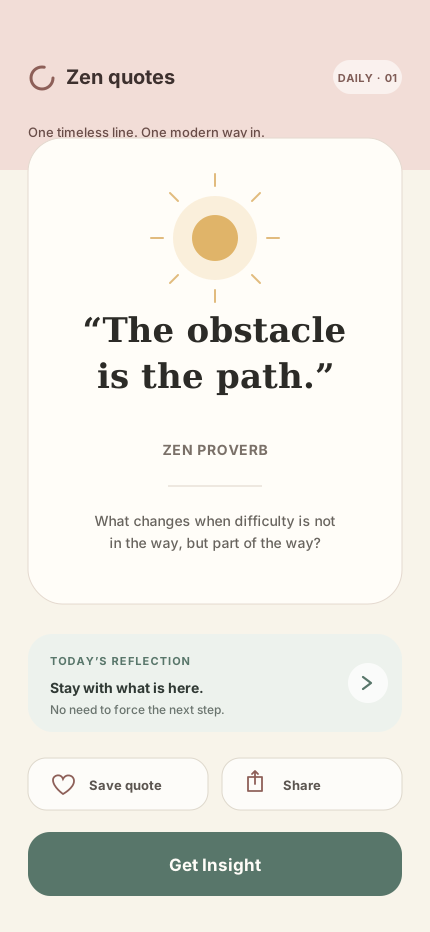
Read one short Zen quote at a time in the interactive reader below. Pause before opening its modern reflection, then let the words meet the day you are actually having.
Read at your own pace
A quiet Zen quote reader
Stay with one line, open its reflection when you want another way in, or move gently to the next quote. Nothing advances until you choose it.
Nothing is missing from the breath you are taking.
ZenDaily original reflection
Modern reflection
The mind often postpones practice until the room is quieter or the mood is better. This breath does not need to become special before it can be felt completely. Begin with the conditions already here.
Let the next step be only the next step.
ZenDaily original reflection
Modern reflection
A difficult path becomes heavier when every future step is carried at once. Feel what this one action asks, without demanding that it solve the whole journey. The following step can arrive after this one is met.
The cup is useful because it has room.
ZenDaily original reflection
Modern reflection
Usefulness is not always another thing added. Space allows a cup to receive, a pause to change a conversation, and an unanswered moment to reveal more than the first conclusion. Notice where making room may be the action.
Listen before deciding what the moment means.
ZenDaily original reflection
Modern reflection
Interpretation arrives quickly and can make experience seem finished. Listen for sound, tone, and what the body already knows before settling on the story. Meaning can remain open long enough for a more honest response.
Begin again without making the beginning a punishment.
ZenDaily original reflection
Modern reflection
Returning does not require a trial about why you wandered. A missed practice, distracted breath, or difficult day can end at the moment you notice it. Beginning again is complete without self-reproach.
Leave enough room for the moment to answer in its own way.
ZenDaily original reflection
Modern reflection
Plans and expectations can speak so loudly that the actual situation is barely heard. Loosen the preferred answer for one breath. The moment may not give what was requested, but it can show what is possible now.
Attention does not need to announce itself.
ZenDaily original reflection
Modern reflection
Presence is often quieter than the idea of being present. It may be the simple feeling of a hand on a cup or the sound at the edge of the room. There is no need to name the experience for attention to be here.
When the path narrows, feel the ground beneath it.
ZenDaily original reflection
Modern reflection
Pressure pulls attention toward everything that might go wrong. The ground offers something immediate: weight, contact, and the support of this step. Returning to the body does not remove uncertainty; it gives uncertainty somewhere to be met.
The ordinary task is not waiting for a more spiritual moment.
ZenDaily original reflection
Modern reflection
Practice is easy to imagine elsewhere—in silence, on retreat, or after the work is finished. Washing a cup, writing one reply, or listening without interruption is already a place where attention can become real.
Put down the answer long enough to hear the question.
ZenDaily original reflection
Modern reflection
A quick answer can protect us from the uncertainty a question opens. Set the solution aside without rejecting it. Listen for what is actually being asked and for the assumptions that arrived before the question was fully heard.
At a glance
A simple place to begin
- Read one short passage instead of collecting many.
- Pause before deciding what the words mean.
- Connect the quote to one ordinary moment in your day.
- Return later and notice whether its meaning has changed.
How to use the quote reader
The reader above contains ten original ZenDaily reflections inspired by Zen practice rather than quotations assigned to a historical teacher. Choose the sentence that creates a little space—or the one you resist. Open the modern reflection when another perspective would help, or leave the line unexplained for a while.
Read the quote once more, feel one ordinary breath, and notice where it touches the day in front of you. If no line feels useful, let that be enough. Zen practice does not require manufactured inspiration. For a rotating quote, koan, and one-minute pause, open today’s Daily Zen path.
Why one quote can be enough
The internet makes it easy to move through dozens of inspiring lines in a minute. Zen practice points in the other direction. A single sentence, read without hurry, can reveal more than a long list skimmed for a quick lift.
A daily Zen quote is not valuable because it sounds mysterious. It becomes useful when it interrupts an automatic way of seeing. A line about change may feel obvious on a quiet morning and completely different during an uncertain afternoon. The words stay the same; the reader and the moment do not.
This is why ZenDaily pairs short teachings with optional modern reflections. The quote comes first. The explanation is there when you want another way into the text, but it does not have to replace your own response.
A simple daily quote practice
You do not need a journal, a perfect routine, or a large block of time. Try this small sequence:
- Read the quote once. Resist the urge to decide immediately whether you agree.
- Take one unforced breath. Notice the body before returning to the words.
- Read it again. Pay attention to the word or phrase that has the most energy for you.
- Connect it to today. Ask where this teaching appears in a conversation, a worry, a habit, or a simple task.
- Let it remain unfinished. You can return later without forcing a conclusion.
The practice can take less than a minute. Its purpose is not to manufacture calm. It is to create enough room to see what is already present.
Reading Zen wisdom without turning it into a slogan
Short quotations are often removed from their historical setting. That can make them approachable, but it can also flatten them into generic motivation. A helpful modern reflection should add context without pretending to settle every meaning.
When you meet a quote, it helps to hold three questions lightly:
- What is the line pointing toward in direct experience?
- What assumption does it disturb?
- What changes if I do not rush to make it useful?
Some teachings feel warm and reassuring. Others are sharp, strange, or inconvenient. Both responses can be part of the practice. Zen wisdom does not always confirm the story we brought to it.
Quotes and koans are related, but not identical
A Zen quote often expresses a teaching in a compact form. A Zen koan usually presents an encounter, question, or statement that resists an ordinary logical solution. Both can interrupt habit, but a koan is more deliberately unresolved.
If a quote gives you language for something you already sense, a koan may take the language away. Neither approach is a test. They are different doors into attention.
Bring the words into ordinary life
The most important part of a daily Zen quote may happen after you close the app. Perhaps the line returns while washing a cup, waiting for a message, or noticing impatience in a familiar situation.
You do not have to remember it perfectly. Let the quote become a small orientation rather than a command. It may encourage you to pause before replying, release a judgment, or feel the ground for one breath.
Daily practice becomes sustainable when it fits inside life as it is. One quote. One pause. One chance to look again.
A daily line, without the scroll
Let one good line meet you each day.
Open ZenDaily for a fresh quote, then choose whether to read a modern reflection, save it, or simply carry it into the day.
Scan to download Opens the right app store4.5 on the App Store · 4.1 on Google Play
Common questions
A little more clarity
What is a daily Zen quote?
A daily Zen quote is a short teaching or passage offered as a point of reflection. It is most useful when treated as an invitation to notice your own experience, not as a slogan you must accept.
How should I reflect on a Zen quote?
Read it once, pause, and notice the first reaction. Then ask where the words touch your actual day. You do not need to reach a final interpretation.
Can I use Zen quotes as a meditation practice?
Yes. You can read a line before sitting, keep it lightly in mind for a few breaths, and then let it go. The quote can open the practice without becoming another task.